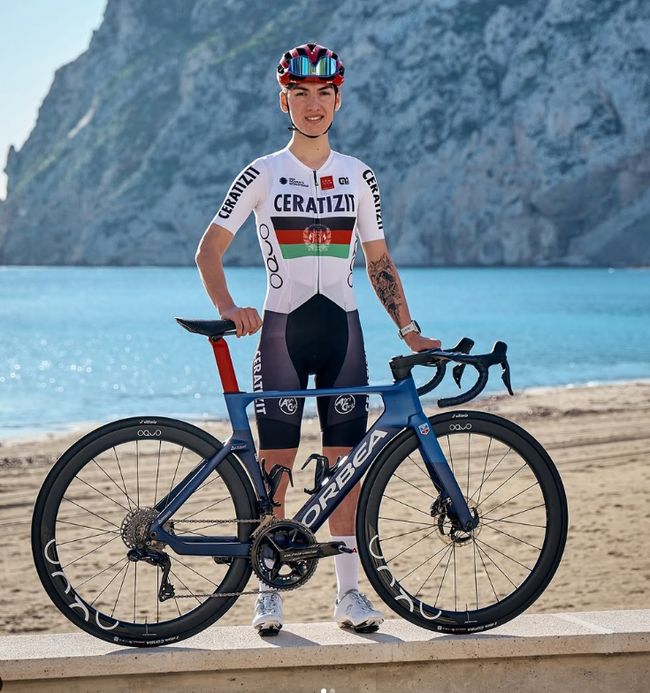
An Afghan cyclist who once disguised herself as a man to train has won a silver medal at the Asian Games, a result she hopes will push other Afghan women toward sport at a time when the Taliban has all but shut the door on them.
What Happened
Fariba Hashimi finished second in the women’s road race at the 20th Asian Games in Aichi-Nagoya, Japan, on Tuesday, racing the Shinshiro Cycling Road Course in Aichi Prefecture. It’s the latest step in a career that began in secrecy back home and now runs through Italy, where she lives and trains.
The silver came two days after Hashimi placed seventh of 14 riders in the individual time trial, finishing 2 minutes 3 seconds behind Kazakhstan’s Rinata Sultanova, who took that event. Road racing turned out to be her stronger discipline this week.
Background — Training in Secret
Hashimi is 23 and started out as a teenager training disguised as a man, alongside her sister Yulduz, who is also now a professional cyclist. Cycling as a woman in public in Afghanistan wasn’t just discouraged — it drew open hostility.
She has described being attacked with stones when she first started riding. That’s not a detail added for color. It’s the baseline she was working from.
Hashimi is from Faryab province in northern Afghanistan and left the country after the Taliban takeover, with help from Alessandra Cappellotto, a former Italian world champion, who got her out and into a training setup in Italy. She and her sister went on to race at the Paris Olympics two years ago.
Since the Taliban returned to power in 2021, authorities have imposed a series of rules restricting women’s access to education and public life, sport included. Afghanistan is one of the only countries in the world today where organized women’s sport barely exists inside its own borders.
In Her Own Words
Hashimi called the result “something special” after the finish, and said it landed harder than a normal medal would.
She was blunt about what’s been taken from Afghan women under Taliban rule: “They took away our freedom, they took away everything from us.” At the same time, she framed the medal as bigger than her own result, saying it shows the resilience of Afghan women and that she isn’t racing alone — millions of women share the same dream.
She also thanked the Japanese team for the role they played in getting her to the podium, noting she raced without a mechanic and relied on one staffer from the national federation just to drive the support car. That’s a small detail, but it says a lot about the resources — or lack of them — behind Afghan athletes competing abroad.
Looking ahead, she mentioned the 2028 Los Angeles Olympics as the next target, saying she doesn’t want to give up and hopes to repeat this on that stage.
Why It Matters
This isn’t just a sports result. For Afghan women who can no longer train openly, compete locally, or in many cases even attend school past a certain age, a podium finish at a major international event is one of the few visible signs that their sporting careers didn’t end in 2021 — they just moved abroad.
Hashimi said she hopes the next generation of Afghan women can eventually compete representing their country without fear. That’s a modest-sounding wish. Given the current situation inside Afghanistan, it’s also a fairly distant one.
What Comes Next
Hashimi’s focus now shifts to the road ahead: continued racing in Italy, and eyes already on Los Angeles 2028. Whether more Afghan women follow a similar path — training abroad, competing under the Afghan flag from exile — depends heavily on support from federations, sponsors, and countries willing to take them in.
FAQs
Does Afghanistan have any Olympic athletes?
Yes. Afghanistan has sent athletes to the Olympics for decades, though in small numbers. Since the Taliban’s 2021 takeover, most Afghan athletes who compete internationally — including several women — train and live outside the country, often in Europe or North America, because organized sport for women is no longer functional inside Afghanistan itself. Fariba Hashimi and her sister Yulduz are recent examples, both training in Italy while still competing under the Afghan flag.
What is the most famous sport in Afghanistan?
Cricket has become the most widely followed sport in Afghanistan over the past two decades, with the national men’s team reaching multiple ICC tournament knockout stages and drawing huge domestic attention. Buzkashi, a traditional horseback game, is often cited as the historic national sport, and combat sports like taekwondo have also produced some of the country’s best-known international results.
Has Afghanistan ever won an Olympic medal?
Yes, but only twice, and both in the same sport. Rohullah Nikpai won bronze in taekwondo at the 2008 Beijing Olympics and again at the 2012 London Olympics. Those remain the only two Olympic medals in Afghanistan’s history, which is part of why results like Hashimi’s Asian Games silver draw so much attention — international medals of any kind are rare for the country.